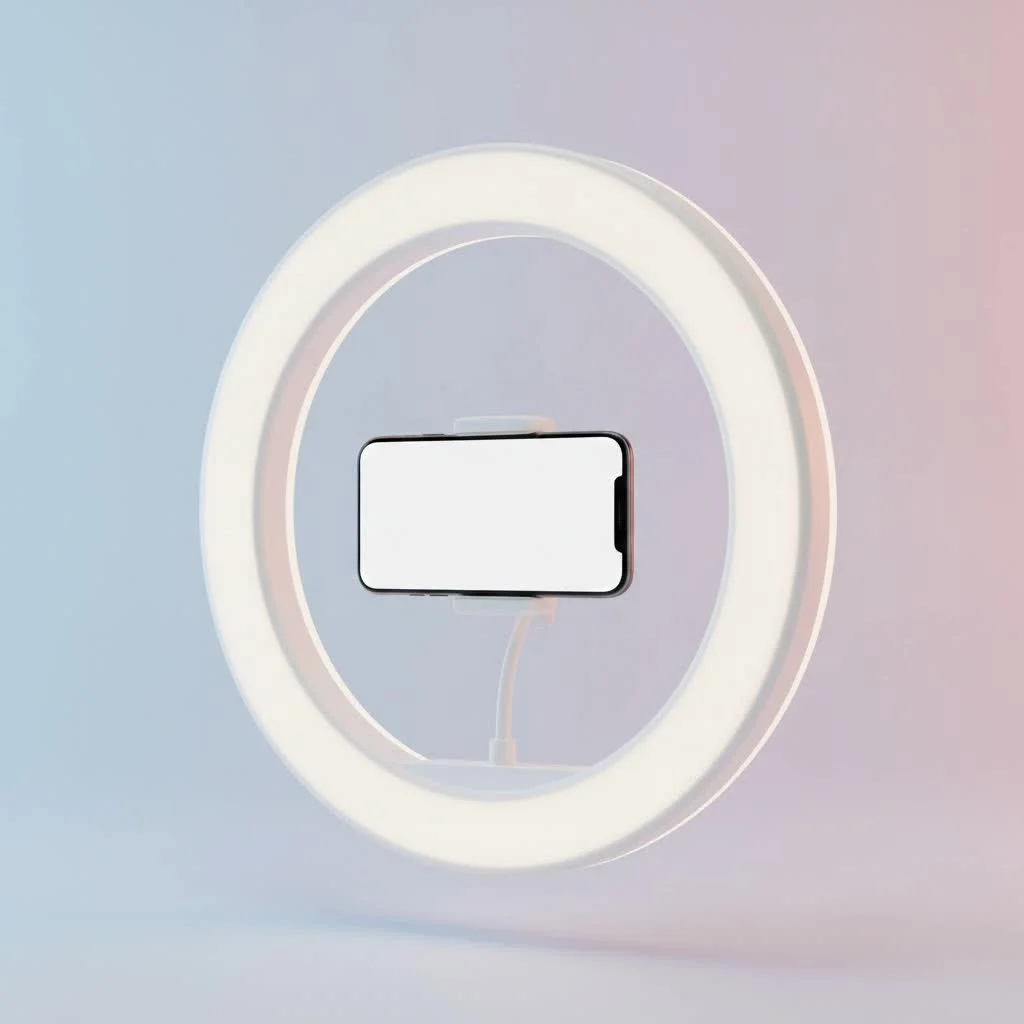
An LED ring light is a circular lighting device composed of many small Light Emitting Diodes (LEDs) that provides uniform, diffused light to minimize shadows and create a flattering glow for content creators, photographers, and video callers. Its unique design allows a camera or smartphone to be placed in the center, ensuring the light source comes directly from the camera’s perspective, which is key to its effectiveness in eliminating harsh shadows and producing captivating catchlights in the eyes.
What is an LED Ring Light and Why Do You Need One?
An LED ring light is exactly what it sounds like: a circular light made up of many small Light Emitting Diodes (LEDs). Its unique shape is designed to cast a uniform, diffused light onto a subject, minimizing shadows and creating a soft, flattering glow. By placing your camera or smartphone in the center of the ring, you ensure that the light source is coming directly from the camera’s perspective, which is the key to its effectiveness.
But why is this so important?
- Eliminates Harsh Shadows: Unlike a single-point light source (like a lamp or overhead light) that creates deep, unflattering shadows under your eyes and nose, the circular design of an LED ring light wraps the light around your face, filling in those shadows for a smooth, even look.
- Creates Stunning Catchlights: The ring shape produces a beautiful circular reflection in the subject’s eyes, known as a catchlight. This adds a spark of life and engagement, making portraits and videos feel more dynamic and professional.
- Provides Consistent, Controllable Light: Natural light is fantastic, but it’s unpredictable and often unavailable. An LED ring light gives you complete control over your lighting environment, ensuring you have perfect, consistent light any time of day, in any room.
How to Choose the Perfect LED Ring Light
With so many options on the market, selecting the right one can feel overwhelming. Let’s break down the key factors to consider to ensure you get the perfect LED ring light for your specific needs, whether you’re a streamer, a makeup artist, or just want to look better on Zoom.
Size Matters: From Desktop to Studio
The diameter of the ring light is one of the most important decisions. Size directly impacts the softness of the light and the area it can cover.
- Small (6-10 inches): These are perfect for desktops, laptops, and on-the-go use. They are ideal for video conferencing, makeup application at a vanity, and close-up selfies. They are lightweight and portable but provide a more focused, less diffused light.
- Medium (12-14 inches): This is a versatile sweet spot for many creators. It’s large enough to provide soft, flattering light for head-and-shoulders vlogging, streaming, and portrait shots without being too bulky for a home setup.
- Large (18 inches and above): These are professional-grade lights used in photography studios. They produce the softest, most wrapping light, capable of illuminating a larger area, including full-body shots. They require a sturdy stand and more space.
Brightness and Power: Decoding Lumens and Watts
|
Our Picks for the Best Ring Light in 2026
As an Amazon Associate I earn from qualifying purchases.
|
||
| Num | Product | Action |
|---|---|---|
| 1 | STALLY 10.2\" Ring Light with Stand, 75\" Tall Ring Light with Phone Holder and Wireless Remote, 12 Dimming Levels, 32 Color Modes Selfie Light Tripod for iPhone, Live Stream, Makeup, YouTube, TikTok |

|
| 2 | Weilisi 12\'\' Ring Light with Stand 72\'\' Tall & 2 Phone Holders,38 Color Modes Selfie Light with Tripod Stand, Big LED Ring Light for iPhone/Android/Camera,YouTube,Makeup |
|
| 3 | 10\" Selfie Ring Light with 73\" Tripod Stand & 1 Phone Holder, LED Camera Ringlight with 48 RGB Colors Modes & Musical Rhythm Mode and 12 Brightness Dimmable for TikTok/Makeup/Photography/Vlog |
|
| 4 | Aureday 14\'\' Selfie Ring Light with 62\'\' Tripod Stand and Phone Holder, Dimmable LED Phone Ringlight for Makeup/Video Recording/Photography, Circle Lighting for All Cell Phones&Lightweight Cameras |
|
| 5 | Upgraded Ring Light for Laptop, Monitor, Desk & Phone – Eye-Caring LED Webcam Light with Screen-Safe Clip, Adjustable Monitor Mount, 50 Lighting Modes, Computer Light for Zoom, Streaming, Video Calls |
|
| 6 | UBeesize 12\'\' Selfie Ring Light with 62’’ Tripod Stand for Video Recording, Live Streaming(YouTube, Instagram, TIK Tok), Compatible with Phones, Cameras and Webcams |
|
| 7 | Weilisi 10\" Ring Light with Stand 72\'\' Tall & Phone Holder,38 Color Modes Selfie Light with Tripod Stand,Stepless Dimmable/Speed LED Ring Light for iPhone & Android,YouTube, Makeup,TIK Tok |
|
| 8 | EMART 10\" Ring Light with 55\" Extendable Tripod Stands and Phone Holder, Dimmable LED Circle Round Light for Selfie Camera Photography/Makeup/YouTube Video/Vlogging/Live Streaming |
|
| 9 | Sensyne 10\'\' Ring Light with 50\'\' Extendable Tripod Stand, LED Circle Lights with Phone Holder for Live Stream/Makeup/YouTube Video/TikTok, Compatible with All Phones |
|
| 10 | NEEWER Basics 10\" Selfie Ring Light with Tripod Stand/3 Phone Holders Compatible with iPhone/3 Cold Shoes/Remote, LED Ringlight Lighting for YouTube TikTok Vlog Video Recording Makeup Streaming, R11 |
|
Brightness is crucial. You need a light that is powerful enough for your environment but also dimmable to avoid overexposing your shots. Look for models that offer a wide range of brightness adjustments, usually expressed as a percentage (e.g., 1-100%). The power, measured in watts, gives a general idea of its potential output, with higher wattage typically meaning a brighter light.
“Don’t just chase the highest wattage,” advises professional portrait photographer, Amelia Grant. “Focus on controllable, dimmable brightness. The ability to dial in the exact amount of light you need is far more valuable than sheer power you can’t tame. The best light is the one that adapts to your scene, not one that forces your scene to adapt to it.”
Color Temperature and CRI: The Key to Natural Tones
Color Temperature, measured in Kelvin (K), determines if the light appears warm (yellowish) or cool (bluish). For the most versatility, choose a bi-color LED ring light that allows you to adjust the temperature, typically from around 3000K (warm, cozy light) to 6000K (cool, daylight). This lets you match the ambient light in your room or create a specific mood.
Color Rendering Index (CRI) is a measure of how accurately the light reveals the true colors of your subject. A CRI of 90 or higher is considered excellent and is essential for photographers, videographers, and makeup artists who rely on perfect color accuracy. A low CRI can make skin tones look washed out or unnatural.
Special Features to Consider
- RGB Capability: Some modern LED ring lights offer a full spectrum of colors (Red, Green, Blue). This is fantastic for creative streamers and content creators who want to use colored light for background effects or artistic looks.
- Power Source: Most ring lights are powered by an AC adapter, but smaller, portable models may be USB-powered or even run on batteries, offering greater flexibility.
- Included Accessories: Look for a kit that includes a sturdy, adjustable stand, a reliable phone holder, and perhaps a remote control for easy adjustments from a distance.
Setting Up Your LED Ring Light for Flawless Results
Once you’ve chosen your light, setting it up correctly is key to unlocking its full potential. A few simple adjustments can make a world of difference.
- Position the Light: Place the stand directly in front of you, with the ring light at or slightly above eye level. This is the classic setup for even, shadowless illumination.
- Mount Your Device: Secure your smartphone or camera in the holder located in the center of the ring. Ensure it’s stable and pointing directly through the middle.
- Adjust the Height and Angle: Tilt the ring light slightly downwards towards your face. This helps create more flattering facial contours and ensures the catchlights appear in the upper portion of your pupils, which looks most natural.
- Set the Brightness: Start with the brightness at a medium setting. Look at your image on the screen and adjust up or down until your face is well-lit without any “hot spots” (areas that are blown out or too bright).
- Dial in the Color Temperature: Adjust the color temperature to match the other lights in your room for a balanced look. For a standard, clean look, a neutral white setting around 4500K-5500K is often a great starting point.
Frequently Asked Questions (FAQ)
Q1: Can an LED ring light damage your eyes?When used correctly at a moderate brightness and for reasonable periods, an LED ring light is safe. Avoid staring directly into the LEDs at full power for extended durations. Most quality lights provide diffused light, which is much softer on the eyes than direct, harsh sources.
Q2: What’s the difference between an LED ring light and a standard lamp?A standard lamp is a point light source that creates hard-edged shadows. An LED ring light is a large, circular source that wraps light around a subject, creating a much softer, more flattering, and virtually shadowless effect, especially for on-camera appearances.
Q3: How far away should I be from my ring light?A good rule of thumb is to be about arm’s length away (2-3 feet). If you’re too close, the light can be harsh and reveal too much skin texture. If you’re too far, you lose the shadow-filling benefits. Experiment to see what distance works best for your setup.
Q4: Do I need a ring light if I have a window with natural light?While natural light is excellent, it’s inconsistent and depends on the time of day and weather. An LED ring light can be used to fill in shadows on a cloudy day or act as your primary light source when natural light isn’t available, giving you consistent, professional results anytime.
Q5: Are more expensive LED ring lights worth it?Often, yes. Higher-priced models typically offer better build quality, more accurate color reproduction (higher CRI), wider brightness and color temperature ranges, and more reliable accessories like sturdier stands. For professional or serious hobbyist use, investing in a quality light is a wise choice.
Your Turn to Shine
The LED ring light is more than just a trend; it’s a fundamental tool for anyone looking to create high-quality visuals. By understanding the key features like size, brightness, and color accuracy, you can confidently select the perfect model for your needs. With the right light and a few simple setup techniques, you can eliminate bad lighting forever and ensure you always look your best on camera. Now go ahead, get creative, and let your content shine.
Frequently Asked Questions
Can an LED ring light cause damage to your eyes?
When used correctly at a moderate brightness and for reasonable periods, an LED ring light is safe. Most quality lights provide diffused light, which is much softer on the eyes than direct, harsh sources. Avoid staring directly into the LEDs at full power for extended durations to prevent eye strain.
What is the main difference between a ring light and a standard lamp?
A standard lamp is a point light source that creates hard-edged shadows, whereas an LED ring light is a large, circular source that wraps light around a subject. This circular design creates a much softer, more flattering, and virtually shadowless effect, especially for on-camera appearances.
What is the optimal distance to position yourself from a ring light?
A good rule of thumb is to be about arm's length away, typically 2-3 feet, from your ring light. Being too close can result in harsh light and over-revealed skin texture, while being too far diminishes the shadow-filling benefits. Experimentation will help you find the best distance for your specific setup.
Is an LED ring light necessary if I have access to natural window light?
Yes, an LED ring light is still beneficial even with natural light. While natural light is excellent, it is inconsistent and dependent on the time of day and weather conditions. A ring light provides consistent, professional results anytime, filling in shadows on cloudy days or acting as a primary light source when natural light is unavailable.
Are more expensive LED ring lights a worthwhile investment?
Often, yes, more expensive LED ring lights are worth the investment. Higher-priced models typically offer superior build quality, more accurate color reproduction (with a CRI of 90 or higher), wider brightness and color temperature ranges (e.g., 3000K to 6000K), and more reliable accessories like sturdy stands. For professional or serious hobbyist use, investing in a quality light is a wise choice.
Get our weekly buyer guide
Practical specs, not advice. Unsubscribe anytime.
I finally invested in a good LED ring light for my YouTube channel, and it’s made such a difference! The diffused light really does minimize shadows, which was a huge problem for me before. My videos look so much more professional now, and the catchlights in my eyes are a nice touch. Definitely worth it for any content creator.
As someone who does a lot of live streaming, a good LED ring light is essential. This one provides such a flattering glow, and I’ve noticed a huge improvement in my on-screen appearance. The fact that the light comes directly from the camera’s perspective really makes a difference in how clear and bright I look. Highly recommend for anyone serious about their streams.
The ring light I got is decent for video calls, but I was hoping for a bit more brightness. It does a good job of eliminating harsh shadows, but sometimes I feel like I need an extra light source for my setup. Maybe I just need to upgrade to a larger model, but for the price, it’s okay.
I’ve been using a ring light for my product photography, and it’s been a game-changer. The uniform light really helps to show off details without any weird glare. I love how easy it is to place my smartphone right in the center for perfect lighting every time. It’s made my product shots look so much better.